Published By Anastasia Hill | Fasting
•
Last update: Feb 26
•
3
609670
4 min

Sticking-out gut. Puffy arms. Heavy thighs.
Whatever it is for you – I know how frustrating and limiting it can feel,” says Dr. Eva Bloom, MD in Gynecology.
“Menopause causes such intense weight shifts that nearly 1 in 2 women (43%) ends up gaining serious fat during this phase.
Many of them start tracking calories, others hit the gym – some even turn to HRT.”
Yet when it comes to shedding menopausal weight, these efforts usually lead nowhere.
And according to the expert, it’s not because women aren’t trying hard enough.
“Researchers from leading universities, including Harvard, have linked cortisol to fat accumulation.
What’s worse, cortisol levels gradually increase with age, making weight loss harder during and after menopause.
This is why I’m determined to teach women exactly how they can naturally reduce cortisol.
But there is a catch – if you try to fix cortisol the wrong way, it can actually spike higher and set you back even more.
Dr. Bloom explains that cortisol’s main role is to prepare your body for perceived threats.
“One of the ways it does that is by raising your blood sugar.
In theory, it’s helpful – a burst of energy for your brain and muscles in moments of danger.
That’s why it’s vital for true “fight-or-flight” situations.
Unfortunately, today’s everyday stress triggers the same response – even when there’s no real danger.
And it’s not just emotional stress – things like irregular eating patterns can confuse your system and trigger the same cascade.
The biggest problem? When the sugar produced in these situations isn’t used, it’s easily stored as fat.
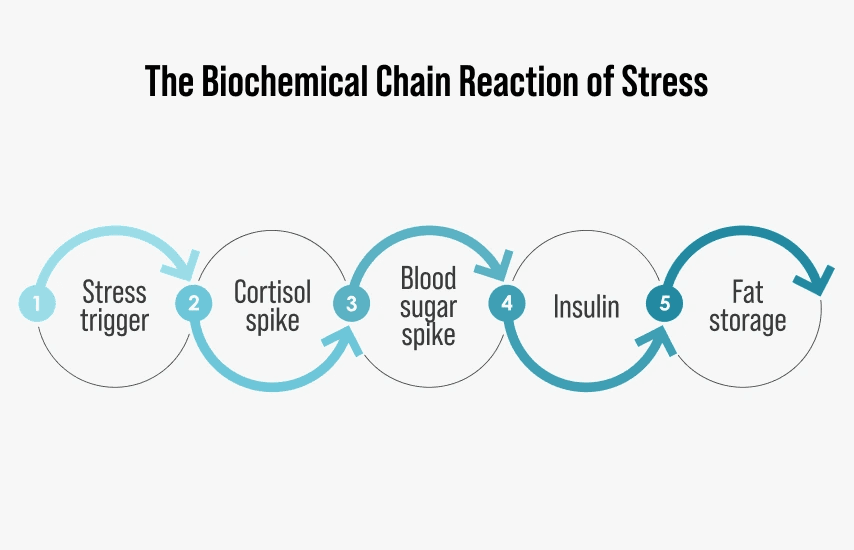
Of course, to bring blood sugar down, your body releases insulin.
But when this response is triggered too often, the body gradually loses its ability to ‘neutralize’ blood sugar.
That’s how fat storage slowly becomes your body’s new normal.
And that’s why it’s crucial to keep your cortisol under control.
On top of that, as cortisol stays high, it gradually throws your hormonal balance off course.
Then the real health risks kick in – from diabetes to heart disease, even cognitive decline.”
Most weight loss advice is built for bodies that play by the rules.
But after menopause, your body doesn’t.
“Women have significantly higher cortisol levels than men – and menopause makes it worse.
That means your body responds differently to stress, food, sleep, and effort.
The same habits that work for others can backfire for you.
Extreme diets and overtraining only raise cortisol higher – keeping you stuck or even storing more fat.
Hormone therapy promises balance, but it often misses the real root causes.
Even pricey injections target symptoms, not the underlying cycle.
That’s why so many women feel stuck, even while doing everything right,” Dr. Bloom concludes.

“You’ve probably heard of it before and maybe even tried it.
But here’s the thing: when done wrong, it can spike cortisol even higher.
And that’s when weeks of progress get erased almost overnight.
However, if you follow the right pattern, it becomes simple:
It’s all about timed pauses in eating – long enough to cool cortisol, short enough to avoid discomfort.
It’s called intermittent fasting. But not the version you see on YouTube or fitness blogs.
We’re talking about a science-backed, menopause-specific approach.
That’s why strategic meal timing, also known as intermittent fasting, has become the go-to method used to unlock fat loss.”
“They found it consistently lowers cortisol levels in middle-aged women and does so more reliably than expected.
Intermittent fasting can be implemented into your lifestyle without side-effects, lifestyle changes or even medication.
What makes this type of fasting different is how reliably it works – confirmed by multiple independent research institutions.
In fact, it holds up impressively well next to more extreme approaches like cold exposure or hormonal therapy.
And unlike those methods, intermittent fasting is actually easy to stick to,” says Dr. Bloom.

“Intermittent fasting works, but only when applied with precision, as proved by the scientists from Seoul National University College of Medicine.
Even relatively small mistakes in timing or food intake can undo the progress.
The key here is to hit the right hormonal rhythm, which isn’t the same for everyone.
This is why following general advice often leads to failure.
In fact, most attempts fall apart because they aren’t tailored to individual needs.
To avoid that, there’s a quick assessment waiting for you at the end of this article.
It reads your habits, needs, and routines. Then it creates your exact plan.”

“It’s also surprisingly easy to maintain,” Dr. Bloom continues.
“That’s the beauty of doing it with guidance – you don’t need to suffer through extreme fasting.
Just a smart, personalized rhythm: slightly longer breaks between meals, and fewer meals per day.
I’ve seen women lose 10, 20, even 50 pounds – not by doing more, but by finally doing what works.
Sometimes, I even have to ask them to slow down.
Because once cortisol and insulin are repaired, the body returns to its natural balance.
That’s when I tell them – you can stop fasting and go back to your usual eating habits.”
The right path is different for every woman. Get a clear plan tailored to your body and your hormones.
START QUIZ
Results may very due to personal features
Copyright © 2026 Health Guardian. All rights reserved. Health Guardian does not provide medical advice, diagnosis, or treatment.